Friday, 11 March 2016

Mrs Dalloway: A Psychoanalytic Reading

A hot London day in June; ‘the swing, tramp, and trudge; in the bellow and the uproar; the carriages, motor cars, omnibuses, vans, sandwich men shuffling and swinging.’ (1) Woolf wrote a novel that narratively explored an ordinary day and the experiences the characters in the novel have on this singular day. The text was to triumph as a literary experiment: Mrs Dalloway (1925). Through various literary techniques, ‘tunnelling processes’ and the exploration of womanhood, Woolf sets up an impressionistic text that can be read through a psychoanalytic lens. Sue Vice describes psychoanalysis as ‘an interpretative strategy, concentrating particularly on the language which tries to render the body’s experiences, the role of sexuality in defining the self, and the construction of subjectivity and gender.’ (2) In this blog post I aim to explore this hot London day and examine the information Woolf sets up for readers to interpret. At times this analysis will cross over into a Feminist reading, however, this is understandable when analysing the position of women in a text that explores the mind of women in such depth.

What Woolf does so cleverly is use one event to explore multiple experiences. This allows the narrative to flow from one mind to another to the outside world and back into another’s mind. One event that highlights this narrative flow so well is the episode with the sky-writing aeroplane: ‘dropping dead down, the aeroplane soared straight up […] out fluttered behind it a thick muffled bar of white smoke.’ (p.17) This single event on an ordinary day allows Woolf to describe the event narratively through multiple characters - both major and minor. ‘“Glaxo,” said Mrs Coates in a strained, awe-stricken voice’ is compared to ‘“Kreemo,” murmured Mrs Bletchley, like a sleepwalker.’ (p.17) The minor characters are given the same significance as characters deemed major, such as Clarissa or Septimus. There is no hierarchy in experiencing life - one experience is not favoured above another - and this single event shows how an ordinary day can become extraordinary through the presenting of characters’ thoughts. Readers need and want these snippets of experience so as to build up a picture of what is occurring in the narrative. 

What aids Woolf in her depiction of this ordinary day through the mind of many is her impressionistic writing technique. She captures the sights, smells, sounds, and more which adds up to create an impressionist collage of a shared experience. If these impressions are repeated throughout life they can cause memories to rise. Take the use of a simple hairpin:
‘But she would remember going cold with excitement and doing her hair in a kind of ecstasy (now the old feeling began to come back to her, as she took out her hairpins, laid them on the dressing-table, began to do her hair), with the rooks flattening up and down in the pink evening light’ (p.29-30)
Throughout the text, certain impressions trigger past feelings. What becomes fascinating is what triggers these memories: hairpins, hat-making materials, fresh morning air. A memory can be triggered by any impression that has stayed long enough with the character to affect them in the same way once again. Through her use of punctuation Woolf is able to draw attention to these triggering objects. The use of parenthesis about interrupts her memory at Bourton, drawing a link between the past and present in the text with the stage direction like description presented in the parenthesis. Woolf emphasises how the ordinary, any usual object, can become extraordinary as it triggers the subconscious. 

The memories of Bourton become a key element in the narrative of Mrs Dalloway when reading it from a psychoanalytic viewpoint. Elizabeth Abel explains that ‘although the Bourton scenes Clarissa remembers span a period of several years, they partake of a single emotional climate that absorbs them into a homogeneous backdrop of the present day in June.’ (3) What become of interest in these memories is what is specifically remembered and the emotions tied to these memories. For Peter, his memories at Bourton are tainted with regret and pain. The memory of Clarissa telling him she was to choose Richard Dalloway is interrupted with the small impression: ‘how sights fix themselves upon the mind! For example, the vivid green moss.’ (p.54) Why is the ‘vivid green moss’ remembered? Do these small remembered impressions allow the reader to place meaning on these puzzle pieces? Woolf spoke of a ‘tunnelling process’ she used to give readers information on characters when she felt it important and necessary. Could these remembered impressions be part of this process? Potentially.For Clarissa, the memories of Bourton are filled with happiness and the remembrance of growth from girl to woman. The different presentations of the Bourton-related memories affect how readers will analyse the characters in the present day. It could be suggested that Clarissa’s fond thoughts of Bourton could be used as a mean to escape the dread she has been feeling all day. For Peter, the past acts as a record of what he perceives as his past failures and causes him to think about his current situation with regards to relationships, employment and his position in life.

Although the relationship between Clarissa and Septimus of importance in the text I want to examine the less explored relationship between Clarissa and Rezia Warren Smith. This allows me to discuss the importance of female space and female relationships with Mrs Dalloway. Clarissa and Rezia are both wives who have been removed from a ‘female paradise.’ (4) This female paradise is a space where women interact with other women, a space that is then interrupted by the War and the patriarchy. The connection between Rezia and Clarissa becomes apparent after Septimus’s death. ‘It seemed to her as she drank the sweet stuff that she was opening long windows, stepping out into some garden’ (p.127) is reminiscent of the opening of Mrs Dalloway where Clarissa remembers ‘she burst open the French windows and plunged at Bourton.’ (p.3) The women are connected by spaces that are open to them. For Rezia it was the hat-making activity with her sister, for Clarissa it was Bourton with Sally Seton. Abel argues that ‘the death of [Septimus] releases Rezia to return imaginatively to a past she implicitly shares with Clarissa: the female-centred world anterior to heterosexual bonds.’ (5) The war acts as a dividing factor for both factors, creating a historical landmark that places them in ‘masculine present’ away from a ‘mythically feminine past.’ (6)

The influence of Sally on Clarissa becomes an influence that Clarissa remembers fondly. Although the ‘exquisite’ kiss they share could be interpreted through a lesbian lens, I argue that this kiss is a cementing of a female bond that Clarissa has, until Sally’s arrival, been devoid of. Woolf gives readers very little information on Clarissa’s childhood, focusing on just the memories of Bourton. Any personal information about Clarissa’s family is revealed by other characters. Readers are told about her sister Sylvia’s death by Peter, and her mother’s death is implied by Clarissa’s reaction after a party-goer informs her ‘she looked tonight […] so like her mother as she first saw her walking in a garden in a grey hat.’ (p.149) It becomes clear that Clarissa existed in a space with little or no influence of other women until Sally takes up residence at Bourton. I argue that Sally becomes a role model for Clarissa and this is why she remembers her so fondly. The kiss is recognition of the sacred bond between Sally and Clarissa, one built on teaching radicalism, gift-giving, and teaching that a mother or sister would have potentially given to Clarissa. 

Ultimately, this is just one reading of Woolf's Mrs Dalloway. However, a psychoanalytic reading has opened up some interesting points of discussion, espcially the history of Clarissa and the importance of female spaces in a text dominated by the aftershocks of the war. Impressionist techniques and free indirect discourse allow Woolf to transform an ordinary day into an extraordinary reading experience as readers are made to recognise the impressions they face everyday and their importance. The use of past and present narrative slips helps Woolf to 'tunnel' behind her characters, revealing (or in some cases keeping hidden) nuggets of information that would provide readers with many ways to interpret characters. The whole text is an experience that one should immerse themselves in to fully appreciate Woolf at her experimental best.

- Josie Cray

(1) Virginia Woolf, Mrs Dalloway, (Oxford: Oxford University Press, 2009)
(2) Sue Vice, 'Introduction,' in Psychoanalytic Criticism: A Reader (Cambridge: Polity Press, 1996) p.1
(3) Elizabeth Abel, 'Between the Acts in Mrs Dalloway' in Virginia Woolf and the Fictions of Psychoanalysis (Chicago: University of Chicago Press, 1989) p.31
(4) ibid, p.34
(5) ibid, p.34
(6) ibid, p.42

Friday, 26 February 2016

Terra Nullis: Post-colonialism and Liminal Spaces in Mansfield's Short Stories

As a Modernist writer existing on the fringes of European Modernist literature, Katherine Mansfield inhabits a complex, post-colonial liminal space. With a number of her short stories set in New Zealand, I intend to examine how Mansfield uses liminal spaces to explore colonialism, arguing that Mansfield, herself, inhabited a liminal space. Defined as 'being on the boundary or threshold, esp. by being transitional or intermediate, between two states, situations, etc' (1) liminality is key when thinking about post-colonial writing. For the Gothic genre, liminal spaces are characterised by windows and doorways. This imagery moves into Modernist stories, seen in Woolf's Mrs Dalloway and other stories. Mansfield's innovative short stories characterise the liminal space as a place of travel and movement. Often characters make journeys on trains, boats, across countries and bodies of water with this time on transportation offering the characters time to reflect on their situations. Wilson contends that 'liminal spaces appear in colonial texts as those terra nullis locations ready to be written upon, interpreted, stolen, and named.' (2)

New Zealand, a colony of the British Empire, can be considered a liminal space. O'Sullivan argues that 'the almost innate belief in most New Zealanders [is] that theirs is a classless community, that the social hierarchies of an older world, if not quite shucked off, one certainly less constraining, has perhaps lead to odd distortions'. (3) This works in tandem with Bennett's observation that 'the transplantation of English culture into a New Zealand context leads to the question of what that culture 'really' looks like.' (4) So, it could be argued, Mansfield was living and working in a liminal, complex space. New Zealand was, as its name suggests, new (to the British Empire). And so, 'the complexity of a New Zealand cultural identity' (5) is something Mansfield addresses in her short stories. Using one of her famous short stories, 'The Garden Party' for analysis, I intend to examine how Mansfield explores New Zealand's cultural complexity from the viewpoint of class hierarchies.

After hearing about the death of a workman who lives close to the Sheridan's property, Laura Sheridan enters a state of contemplation. Is it still okay for the Sheridan's garden party to go ahead when a man from the neighbouring cottages has died? Would it be rude to the grieving wife? This accident and situation allow Mansfield to unpack ideas surrounding class in New Zealand. The dead workman is described as a 'drunken workman' (6) by Jose with Laura questioning this claim. The Sheridan's house and class position are then juxtaposed with the cottages, as Mansfield creates an image that highlights class disparity:

'The very smoke coming out of their chimneys was poverty-stricken. Little rags and shreds of smoke, so unlike the great silvery plumes that uncurled from the Sheridans' chimneys' (p.343)

Mansfield subtly highlights how class is societal concern that still prevails in New Zealand, despite the belief that New Zealand might describe itself as classless. The 'broad road' that separates the Sheridan's from the 'little mean dwellings' (p.343) acts as a threshold between two very different class situations. The road towards the Sheridans' house Laura travels to arrive at the cottages is 'gleamed white' (p.347) in contrast to the lane the cottages are placed on which is 'smoky and dark' (p.347). This road acts as a liminal space that Laura inhabits before she comes face-to-face with death and the privilges of her own class.  O'Sullivan notes that 'Laura's early amazment at a workman's delighting in the scent of lavender is merely a novice's version of her mother's fully fledge snobbery.' (7) Laura moves in an unstable place between recognising her position and understanding the luck of being born into a certain family at a certain time. The story of 'The Garden Party' allows Mansfield to deconstruct the notion that New Zealeand is a classless community. She uses liminal spaces so her characters can reflect on their position in the colonial community.

Mansfield found herself in the 'broad road', not able to idenitify as an indigenous New Zealanders nor what can be considered a "British citizen". Referred to as the 'little colonial' at school in Britain, Mansfield faced a 'liminal positioning between empire and colony.' (8) Bennett describes Mansfield position in relation to New Zealand - 'as an indentity and indentification - is a place that defines Mansfield above all, as displace, as placeless.' (9) Writing from this 'placeless' position, a space between two identities, Mansfield was able to examine life and identity from a unique position. Seen as the 'other,' Mansfield was able to explore liminal spaces and how they impact characters in her short stories in relation to post-colonialism and how being between two spaces affects indentities.

Josie Cray

(1)'liminal' adj. OED
(2) Wisker, Gina. (2007) "Crossing Liminal Spaces: Teaching the Postcolonial Gothic" Pedagogy: Critical Approaches to Teaching Literature, Language, Composition, and Culture, 7. 3 pp.401-26 (p.412)
(3) Mansfield, Katherine, New Zealand Stories, ed. by Vincent O’Sullivan (Auckland: OUP Australia and New Zealand, 1998) p.8
(4)Andrew Bennett, Katherine Mansfield (United Kingdom: Northcote House in association with the British Council, 2002) p.42
(5) Bennett, Katherine Mansfield, p.42
(6) Katherine Mansfield, Selected Stories, ed. by Angela Smith (New York: Oxford University Press, 2008). p.344
(7) Mansfield, New Zealand Stories, ed. by Vincent O’Sullivan, p.9
(8) McLeod, John, ed., Routledge Companion to Postcolonial Studies (Routledge Companions) (London: Taylor & Francis, 2007) p.3
(9) Bennett, Katherine Mansfield, p.43

Monday, 22 February 2016

Extraordinary Dynamism: Woolf, Mansfield and Modernism


Extraordinary Dynamism: Woolf, Mansfield and Modernism 


Virginia Woolf and Katherine Mansfield were literary contemporaries, rivals, and had deep personal connection. Both invested in what new modes of expression could offer in the 20th century.  This was a process in which they could share similar political and social concerns, and attain some degree of self-actualisation for themselves and women more generally. This has allowed their work to be read together and separately when considering their own contribution to modernism.

Hermione Lee outlines both the personal and professional relationship between Woolf and Mansfield ‘So the remark about ‘friendships with women’ comes out of the heart of her extremely complicated relationship with Katherine. Their friendship was intimate but guarded, mutually aspiring to be competitive (If she’s good then I’m not). It ultimately disappointed her, but it was always tugging at her.’ This uneasy relationship had a deep affect on Woolf that would continue for many years after the death of Katherine Mansfield. It suggests that this rivalry limited the process of their work, but also encouraged them to create new meaning in a competitive environment, however damaging that potentially could be.  Lee continues ‘There were many crucial things about her that Virginia failed to understand, or understood too late – her background, her marriage, her illness. She was often snobbish and unkind about her. And Katherine too was ambivalent and inconsistent.’ This inconsistency from both led to a certain depth of misunderstanding. Alexandra Harris argues ‘But the relationship would be full of reserve, defensiveness, offences given and inferred. Mansfield lashed out with criticism, giving Night and Day a cold review. They felt they were working on the same things, but that made them all the more guarded with each other.’  This was a literary and personal friendship, and yet this was consequential in terms of their own work.

"I was jealous of her writing - the only writing I have ever been jealous of."
Woolf reflecting in her journal on the death of Katherine Mansfield

However, it is important to consider the different personal, geographical and social circumstances hat Katherine Mansfield and Virginia Woolf held and how this worked into their own writing. Mansfield for example, had a natural interest in the uneasy relationship between Empire and its colonies and complications that arose around this. Woolf wrote from a different perspective, arguably a one of privilege, although she too sought to challenge this. 

The positive legacy of pairing these two writers together thematically is what they sought to achieve when explaining the positioning of women in society and how this can be problematised. Both Woolf and Mansfield represent women who were stringently forced into roles which may not have naturally suited them. Katherine Mansfield writes about this in her short story Bliss (1918). Bertha on discovering her own sexual independence and desire, discovers her husband’s affair with a friend. This hypocrisy is painfully displayed in Bertha, whilst juxtaposing this with her husband’s sterile, unemotional and ambivalent attitude towards the affair.  Mansfield is also writing about class too; the lives of middle class women who are left to sink or swim in terms of the limited domestic roles that are available to them.  Virginia Woolf also discusses these issues in many of her works, from characters such as Katharine Hilbery in Night and Day (1919) and more famously perhaps, Clarissa Dalloway in Mrs Dalloway (1925). Characters in these stories, from both Mansfield and Woolf all have some sort of epiphany in terms of realising their true selves. This was something that they were both interested in; the ability to consider yourself in terms of what people can stand for. Most of these realisations however were thwarted by power structures that existed for both genders in the early 20th century.  


This post is only a short examination of what Woolf and Mansfield’s work can offer when making thematic connections. Both contributed hugely to modernism and its concerns; a serious, and pressing need to make new literature. This shift away from traditional narratives and forms is something that is still being negotiated. Whilst their own relationship was troubled, it was also one that has an extraordinary dynamism to what could be created, thought upon, and realised in a period of significant change. 

Saturday, 6 February 2016

The Androgynous Mind in Virginia Woolf's 'A Room of One's Own'

While the term 'androgynous' may appear to undermine gender dualism -- which is predicated on gender essentialism -- on initial inspection, its truly neutral sense proves impossible in a patriarchal context. As Simone de Beauvoir argues in her introduction to The Second Sex (1949): 'man represents both the positive and the neutral, as is indicated by the common use of man to designate human beings in general; whereas woman represents only the negative, defined by limiting criteria, without reciprocity.' Furthermore, its implications in those individuals largely perceived as men (so clumsily termed because 'androgynous' has such a capacity to question our perceptions of other people's genders) are to effeminate attributes - a word which seems to carry exceedingly negative connotations.

To see the use of this word in Virginia Woolf's 'A Room of One's Own' however was rather exciting. Perhaps she could reclaim it for all its deviating qualities! She starts by questioning mental disparities between individuals of different sexes: 'Why do I feel that there are severances and oppositions in the mind, as there are strains from obvious causes on the body?' (p.92) Why indeed. Then, introducing this notion of unity that the term 'androgyny' would imply, she further questions, 'But the sight of two people getting into the taxi and the satisfaction it gave me made me also ask whether there are two sexes in the mind corresponding to the two sexes in the body, and whether they also require to be united in order to get complete satisfaction and happiness?' (p.93). While I dispute the dualism of this suggestion, and that they correspond  necessarily to the sex of each individual, Woolf also appears to suggest that all individuals have access to a wider range of mental attributes than merely those that are assigned to one's gender.

Unfortunately, Woolf then begins to reinforce gender essentialism with the notion of how one gendered mind predominates  over the other to parallel whether that person is a man or a woman: 'In each of us two powers preside, one male, one female; and in the man's brain the man predominates over the woman, and in the woman's brain the woman predominates over the man' (pp.93-4). Considering that androgyny denotes "hermaphroditism" - or intersex people - their fit into this now reinforced binary is disregarded.

She continues this vein of thought in suggesting a unity in the opinions of each gender: 'Do what she will a woman cannot find in [supposedly "masculine" books written by men] that fountain of perpetual life which the critics assure her is there. It is not only that they celebrate male virtues, enforce male values and describe the world of men; it is that the emotion with which these books are permeated is to a woman incomprehensible. […] The emotion which is so deep, so subtle, so symbolical to a man moves a woman to wonder' (p.97). This suggests that women all feel the same about writing which celebrates male virtues, enforce male values and describe the world of men. Woolf does not clarify what these supposedly gendered virtues and values are and I confess I know not a virtue or value that is specific to men. There is apparently an essential incapacity for one gender to understand an emotion of another gender, if it pertains to only the "masculine" mind or the "feminine" mind.


Woolf returns to suggest of writing without one's gender: 'It is fatal for anyone who writes to think of their sex. It is fatal to be a man or woman pure and simple; one must be woman-manly or man-womanly. […] It is fatal for a woman […] in any way to speak consciously as a woman' (p.99). Perhaps my distrust of gender essentialism would suggest me to be empathetic with this idea, but I am not. I do not deny commonality in gender, but find this most perceptible  in the experience of individuals of the same gender, not in essentially inherent characteristics. That is to say, to refer to Alex Zwerdling's article, 'Anger and Conciliation in Woolf's Feminism', that the 'subjection of women' against which Woolf rightly holds considerable anger, is common to womankind. So, if one is not to speak consciously as a woman, but rather as neutral with an androgynous mind, one does disservice to the unexplored capacity of female writing. To apply my own questioning of strangely gendered terms such as "female writing", what is that if we are denying gender essentialism? Hélène Cixous' theory of écriture féminine is problematic in its own gender essentialism by suggesting that a feminine form of writing should write out of, and to the rhythms of, a female body. Susan Billingham however has suggested of the capacity to adapt Cixous' theory to transwomen and one could go further to expand the notion to other marginalised genders, because thereby one can write out of the shared experience of gender-based oppression. To adopt a neutral voice when one is starved of a voice will do nothing to quench that need, but to return to Simone de Beauvoir's claim, the neutral is absorbed back into the dominance of men.

Monday, 16 March 2015

Katherine Mansfield and the Problem of Time in 'How Pearl Button was Kidnapped'

Katherine Mansfield’s early stories first published in the magazine Rhythm, are heavily influenced by the works of philosopher Henri Bergson. His work introduced two ways of knowing time: intellectual and intuitive. The former being the way we formally recognise the time, measured by a series of artificial units and the latter is the way we “psychologically experience time, or what Bergson calls ‘duration’”. However, the most important aspect of Bergson’s theory is the fact that spatialised, intellectual time has already passed; it is documented and measured and can only be represented. A useful allegory for this would be a third person account of an event that happened. However, intuitive time is a psychological time, passing right now.

These aspects of the human consciousness are inseparable. They are created by the degree of tension or relaxation within the consciousness. When the mind is most tense, the intellect takes over but when more relaxed, intuition does. This means that our consciousness introduces different rhythms; it is changeable in terms of its relation to intellect and intuition.

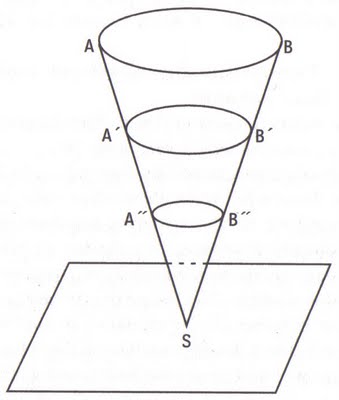
In this sense, it is integral to consider that Mansfield does not simply write stream of consciousness narratives because time cannot simply be measured by the intellect or intuition. This is perfectly illustrated by Bergson, below where the inverted cone stands on its apex (S) on a rectangular plane (P) with its base (AB) uppermost:


The cone represents the

totality of the recollections accumulated in my memory, the base AB, situated in the past, remains motionless, while the summit S, which represents at all times my present, moves forward unceasingly also touches the moving plane P of my actual representation of the universe. At S the image of the body is concentrated; and, since it belongs to the plane P, this image does not but receive and restore actions emanating from all images of which the plane is composed.

The present never exists in the intuitive sense, it acts whereas the past merely exists and does not act, anymore. The past and the present are “united in the sense that human consciousness moves freely between them, or anywhere inside the cone”.

Mansfield’s 1910 short story ‘How Pearl Button was Kidnapped’ closely adheres to Bergson’s theories because Pearl’s experiences are constructed through the co-existence of contradictory intuition and intellect. Indeed, the title introduces the possibility of violence and shock; however, as the story progresses, it is clear the reader must identify how Mansfield reveals this not in the uncanny representation of the Maori community, but in the more familiar faces, the “little blue men” (or policemen) who ‘kidnap’ Pearl, snatch her from a place where she enjoys herself and “carry her back to the ‘House of Boxes’”. Mansfield’s abrupt, matter of fact tone suggests that these men are the intruders in the narrative. Besides, Pearl never seems to fear her ‘kidnappers’. Mansfield evokes a quasi-maternal bond between them because the woman “was softer than a bed and she had a nice smell- a smell that made you bury your head and breathe and breathe it”. Her ‘kidnappers’ are a source of comfort but it is her family and the police who brutally snatch her from this happiness and force her to return to her boring life in the “House of Boxes”, where she is no longer free or mobile.

Mansfield’s style is extremely ambiguous. There are only three paragraphs in this short story and the reader would expect the first to break with a temporal conjunction like ‘then’ between the sentences: “She swung on the little gate, all alone, and she sang a small song” and “Two big women came walking down the street”. Contrary to the expectations of an adult reader, events in the story- from Pearl swinging on the gate, the winds blowing up the street dust, Pearl singing, and the two big women walking towards her- happen in a continuous flow. This narrative technique implies that within Pearl’s consciousness, there are no breaks or paragraphs that sort things out ‘intellectually’. The story is told through Pearl’s intuitive consciousness, where time is experienced as duration rather than as measured and spatialised; therefore, Mansfield’s narrative could not follow a linear structure.

Mansfield’s methods regarding paragraphing demonstrate how the narrative is based on the child’s experience of duration. In fact, Pearl does not does not experience ‘kidnapping’, nor does she identify the two women as Maori. The reader is invited to follow Pearl’s sense of intuitive perception instead of intellectual identifications.

However, as Eiko Nakano identifies, Pearl might not know that the two women can be ethnically described as Maori, but this does not mean that she does not identify them intellectually. She gives her own definitions to what she sees or knows both at home and in a new environment. When she is asked where her mother is, she answers: “In the kitching, ironing-because-it’s-Tuesday”. The fact that Pearl can immediately link ironing and Tuesday indicates that she can identify what she knows in an adult, intellectual way. Similarly, when she goes to sit on the dusty ground: “she carefully pulled up her pinafore and dress and sat on her petticoat as she had been taught to sit in dusty places”. As a result of her upbringing, as Nakano argues, Pearl “instantly reacts to dust and automatically sits in the best way of sitting in such a place”. As she eats the peach, she worries the juices will spill onto her clothes. Unlike her mother, Pearl is not trapped within the ‘House of Boxes’, repeating the same ironing every Tuesday, she is mobile. Her consciousness moves, continually between the intellectual and the intuitive.

The title reinforces the intellectual perspective because we can take a step into Pearl’s consciousness (where intuition reigns) in a dreamlike state but it is only when we finish the story (much like waking up) that we can interpret the story more intellectually and realise that Pearl’s mother had obviously sent out a search party for Pearl, yet our intuition tells us that the little blue men, the uncanny yet recognisable figures of policemen are to take her home to safety. What represent the ‘House of Boxes’ to Pearl, in fact restores order.

Henri Bergson describes time which is flowing and a time which has flown with an artistic metaphor: “The finished portrait is explained by the features of the model, by the nature of the artist, by the colours spread out onto the palette” but Bergson goes on to explain that not even the artist could have foreseen how the portrait would turn out “for to predict it would have been to produce it before it was produced- an absurd hypothesis”. Interestingly, Mansfield’s title allows the reader to anticipate something before reading it yet the story turns out differently than expected: the reader is the artist who creates lives by “reading the story about these lives”. The reader produces a portrait of the narrative in their consciousness, open for new interpretations.

Mansfield’s story paints the portrait of Pearl’s consciousness. Colours are extremely significant because Pearl may not know what specific things are called, but she takes in the visual richness of her surroundings. For instance. When she first meets the two women, they are introduced in relation to the clothes they wear: “One was dressed in red and the other was dressed in yellow and green. They had pink handkerchiefs over their heads”. Yet Mansfield’s language is especially perceptive in that Pearl makes “a cup of her hands” and catches some water from the sea: “it stopped being blue in her hands”. These changing colours hold a strong resonance because it describes the way Pearl is a part of nature yet takes part in creating it, too. She paints the portrait of the external world within her consciousness. Her excitement at changing the water’s colour, the way “she rushed over to her woman and flung her little thin arms round the woman’s neck, hugging her, kissing” is urgent and active but describes the way Pearl creates the scene surrounding her, inviting the reader into her consciousness to experience that same excitement.

The significance of intellectual and intuitive time in Bergson’s theory is indivisible in his philosophy and in Mansfield’s writing. Location is a significant feature in her early works but what makes Mansfield stand out as a Modernist writer is her ability to express the ways in which her characters experience time as linear and spatialised as well as intuitive.

Niamh Hughes

Works Cited
Bergson, Henri, Creative Evolution, A. Mitchell (trans.) (London: Macmillan, 1911)
-Matter and Memory, N.M. Paul and W.S. Palmer (trans.) (London: Allen and Unwin, 1911)
Mansfield, Katherine, ‘How Pearl Button Was Kidnapped’ in Selected Stories (Oxford: Oxford World’s Classics, 2002)

Nakano, Eiko, ‘Katherine Mansfield, Rhythm and Henri Bergson’ in Katherine Mansfield and Literary Modernism eds. Gerri Kimber, Susan Reid & Janet Wilson (London: Continuum, 2011)

Friday, 13 March 2015

David Jones: Painter and Poet


An epic poem in its own right, In Parenthesis is rooted in David Jones' experience as a soldier in the Royal Welsh Fusiliers during the First World War. Over two decades after Jones enlisted in 1914, In Parenthesis is an attempt to faithfully deliver his experience of life in the trenches. Starting as a series of war drawings with captions, the captions grew into "a writing", and from there he had a new objective: 'to make a shape in words'[1], or put more eloquently, 'to see how this business of 'form' and 'content' in a writing, compared with the same problems in [...] the visual arts'[2]. It is the evolution from painting to poem, that provides us with a beautiful 'landscape of language' that allows what a painting lacks: motion and sound.


 Painting by David Jones,Frontispiece for In Parenthesis, 1937,©Estate of David Jones


For example, at the close of Part Two, there is an explosion while John Ball is being reprimanded for his failure to address an officer properly (which says a great deal about the importance of hierarchy), and the scene's impact on the reader is, like the explosion itself, atomic:

[. . . ] in a stillness charged through with some approaching violence -registered not by the ear nor any single faculty -- an on-rushing pervasion, saturating all existence; with exactitude, logarithmic, dial-timed, millesimal – of calculated velocity, some mean chemist's contrivance, a stinking physicist's destroying toy. Out of the vortex, rifling the air it came -bright, brass-shod, Pandoran; with all-filling screaming the howling crescendo's up-piling snapt. The universal world, breath held, one half second, a bludgeoned stillness. Then the pent violence released a consummation of all burstings out; all sudden up-rendings and rivings-through -  all taking-out of vents - all barrier-breaking, all unmaking. Pernitric begetting  -  the dissolving and splitting of solid things. (p. 24)

In vivid slow motion, we are confronted with both stillness and velocity, a howling crescendo and a 'pernitric begetting'. This extract, like the rest of the text, is so visually striking that both the words, and the images they create, leave a lasting imprint on the reader.
Alongside his use of memory and vivid imagery, Jones also breaks out into poetry in times of great emotion. In Part Three, it seems that prose cannot bear the weight of John Ball's fear and a more expressive medium of poetry is needed:

You can hear the silence of it:
you can hear the rat of no-man’s land
rut-out intricacies,
weasel-out his patient workings,
scrut, scrut, sscrut
                                (p. 54)
Drawing our attention to the oppressive silence, this section demonstrates poetry's ability to compensate for what prose may lack; that is, that the aesthetics of poetry seem to help isolate the emotions and actions displayed. Prose, in turn, may provide a more emphatic way of conveying memories and experience than painting.

For this reason, it is easy to understand the indecisiveness of its genre: Is it a novel, a poem, or a "word painting"? Is it surely not all of these?


Sammy Evans.


[1] David Jones In Parenthesis London: Faber and Faber (1937) pX. 
[2] Jonathan Miles Eric Gill & David Jones at Capel-y-ffin Bridgend, Wales: Seren (1992) p155.

Tuesday, 3 March 2015

In Parenthesis – What is it?

David Jones's In Parenthesis is a work that defies easy categorisation. My edition clocks in at over 220 pages if you include Jones's extensive endnotes, features seven parts or chapters, and is composed of (mostly) left-aligned prose of regular line-length. All of which seems to suggest that Jones's World War I narrative is a novel.

The good people at Faber & Faber seem to disagree, though.


Cover art isn't the only factor that complicates our reception of In Parenthesis as a novel though. The sheer density of allusion and variety of rhythmic features also suggest that sections of In Parenthesis are, in fact, works of poetry. 

In Part 4 of the text, for instance, Dai Greatcoat delivers a lengthy speech:

I am '62 Socrates, my feet are colder than you think
on this
Potidaean duck-board.
   I the adder in the little bush
whose hibernation-end
undid,
unmade'victorious toil:
In ostium fluminis.
At the four actions in regione Linnuis
                             by the black waters. (p. 80)

This text demands close attention – there are footnotes to consult, classical references to unpick, and mid-sentence line-breaks to consider – offering a reading experience that is perhaps closer to that a poem than a novel.

So how can we go about deciding what In Parenthesis is? George Szirtes defines poetry as a form in which 'the presence burns more than the narrative drive.' If we accept this definition as true, then it seems as though In Parenthesis could be quite confidently categorised as a work of poetry rather than a novel. Jones's depictions of trench warfare and military life are vividly rendered, while the causal conditions that drive these military men to action are comparatively muddled.

But would a causally sensible narrative be appropriate for a depiction of the Great War? In Part 6, John Ball and his company advance over no man's land, marching through the din of gunfire to arrive at a shallow trench opposite enemy lines:

Rain clouds thickened to wintry dark across the summer night, broke a soaker over them, more confused them where some sought with inutile tools to deepen against his retaliatory fire. Or some just curled up and chanced it. […] When daylight fully came they were withdrawn across the open, which seemed silly, and he obviously saw them and put across Wooly Bears [heavy German shrapnel] low over them scampering like disturbed game. (pp. 147 – 148)

Before long, Ball and company withdraw even further, giving up the ground they have painfully gained just hours before. At no point in this self-cancelling exercise have these soliders known where they were  or what they were doing there, but it is clear that the cost has been high:

God knows what it was all about, but they moved you back again that evening to another field of bivouac.
And you saw the whole depth of the advance and gauged the nature of the contest yard by yard, and made some estimate of the expenditure and how they'd bargained for each hundred feet with Shylock batteries. You marked how meshed intricacies of wire and cunning nest had played sharp tricks on green and eager plaintiffs. They lay heaped for this bloody suing. (pp. 147-148)

Perhaps In Parenthesis does favour presence over narrative drive, or perhaps the historical narrative that it is depicting simply doesn't make sense.

Of course, David Jones is far from the only modernist writer to have tested the boundaries of formal convention. Virginia Woolf's shorter writings, for instance, frequently operate at the boundary between short story and poetry. 'Monday or Tuesday' and 'Blue and Green' could both be read as short pieces of prose poetry, and it's clear from Woolf's critical writing that she was very much aware of this liminal quality in her work. 

In 'Modern Fiction' (available online here), she argues that:

[The writer] has to have the courage to say that what interests him is no longer "this" but "that": out of "that" alone must he construct his work. For the moderns "that", the point of interest, lies very likely in the dark places of psychology. At once, therefore, the accent falls a little differently; the emphasis is upon something hitherto ignored; at once a different outline of form becomes necessary, difficult for us to grasp, incomprehensible to our predecessors. […] The emphasis is laid upon such unexpected places that at first it seems as if there were no emphasis at all […] But it is impossible to say "this is comic", or "that is tragic", nor are we certain, since short stories, we have been taught, should be brief and conclusive, whether this, which is vague and inconclusive, should be called a short story at all. 

In a sense, then, writers such as Woolf and her 'modern' contemporaries were engaged in the creation of hybrid forms that could serve as better vessels for the jarringly new experience of modernity. But unlike the key canonical figures of the modernist movement, Jones actually experienced the first great war of modernity in person. As such, it is perhaps unsurprising that his need for formal experimentation seems especially urgent, and that his text should defy our attempts at definition.

James Nouch